
In Earl Derr Biggers’ second Charlie Chan mystery, The Chinese Parrot (1926), wall street financier P.J. Madden is dead set on buying a highly valuable and famous strand of pearls: the Phillimore Pearls. Detective Charlie Chan submitting to sentiment towards his old Hawaii employer, the pearl’s seller, is roped into delivering the pearls to Madden at his desert ranch. Of course all is not as it seams and a mystery unfolds. However that’s not the story. This is about that ranch.
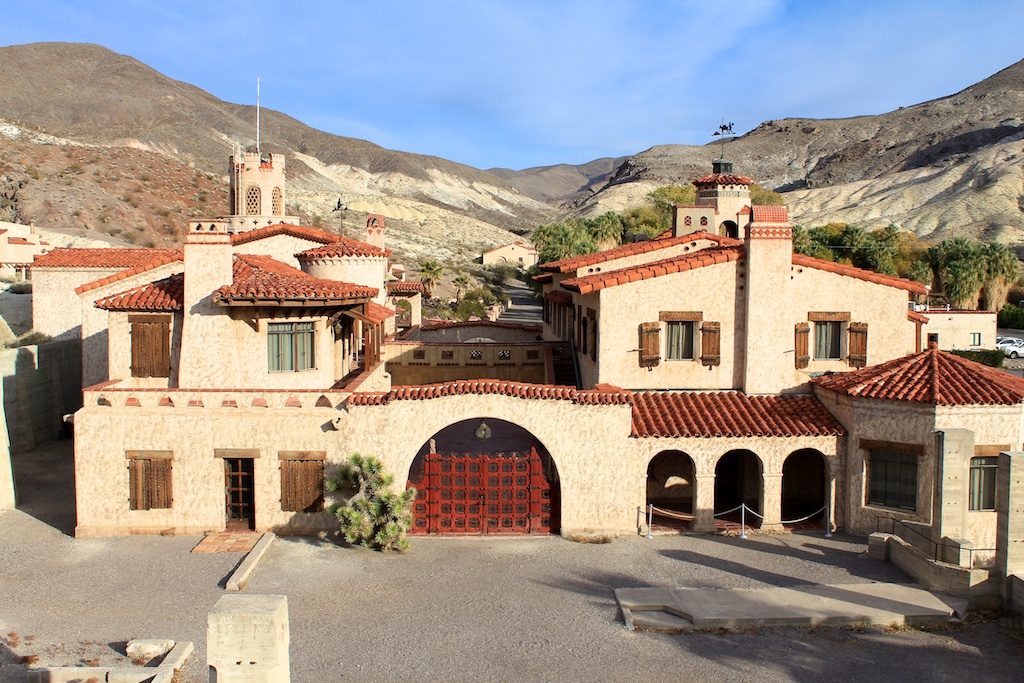
Well, it just so happens there was a strange, lavish Spanish design house ($1.5-$2.5M) built in Death Valley in 1922, known as Scotty’s Castle! The history of this site is truly unique. But first, let’s take a look and compare the fictitious ranch to the actual one. Then, you can judge for yourself if Scotty’s Castle was actually Biggers’ inspiration for P.J. Madden’s ranch in the desert!
Madden’s ranch (delivery location of the pearls is later changed to the ranch):
"The necklace will be delivered to me in New York," he remarked to Eden, ignoring his daughter and Thorn. "I'll be in the south for some time--got a place in Pasadena and a ranch on the desert, four miles from Eldorado. Haven't been down there for quite a while, and unless you look in on these caretakers occasionally, they get slack.

-The Chinese Parrot, 1926, Chapter 1, The Phillimore Pearls
Now Scotty’s Castle is not four miles from Eldorado, CA; more like 6 or 7 hours. Still, at the time he wrote this his second Chan novel Biggers was living in Pasadena, CA. Construction on Scotty’s Castle began in 1922 and Biggers wrote The Chinese Parrot in 1926. A simple matter to take a writer’s prerogative on the distance…I mean it was fiction! And while the castle remained under construction into the 1930s (never actually completed,) it’s highly probably Biggers knew of it living in Pasadena and may have worked it into the book.
Further description from the novel of Madden’s ranch:
The ranch house was a one-story structure, eloquent of the old Spanish days in California before Iowa came. Across the front ran a long low veranda, the roof of which sheltered four windows that were glowing warmly in the chill night. Holley and the boy crossed the tile floor of the porch, and came to a big front door, strong and forbidding.

- The Chinese Parrot, 1926, Chapter 5, Madden's Ranch
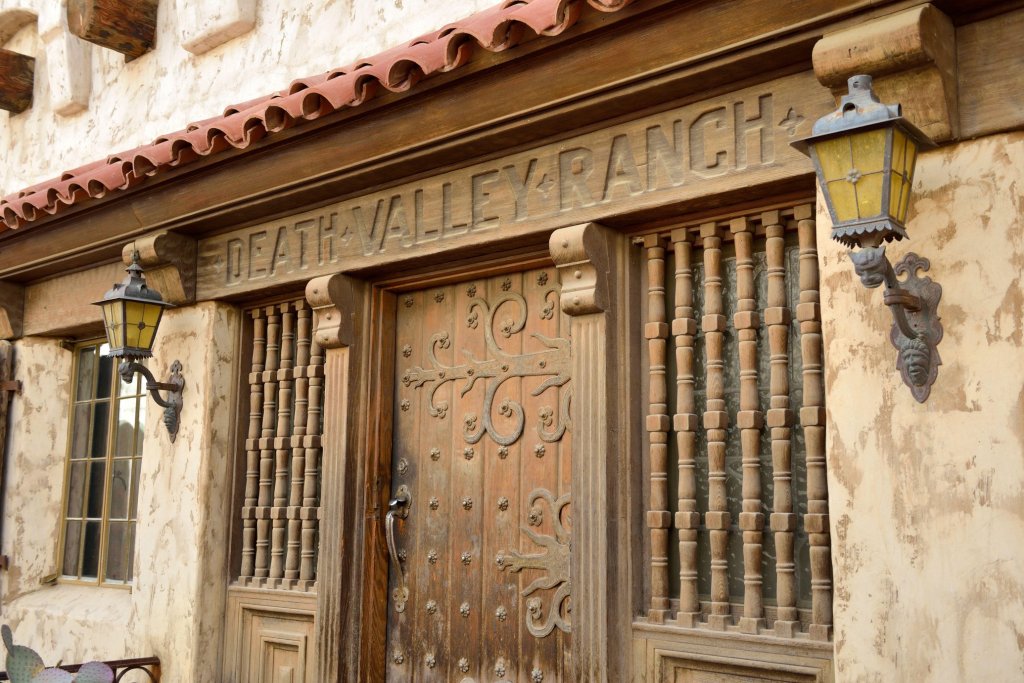
Entrance to Scotty’s Castle:
And finally, from the novel:
The secretary disappeared through a door at the rear, and left the two callers standing in the great living-room of the ranch house. To step from the desert into a room like this was a revelation. Its walls were of paneled oak; rare etchings hung upon them; there were softly shaded lamps standing by tables on which lay the latest magazines--even a recent edition of a New York Sunday newspaper. At one end, in a huge fireplace, a pile of logs was blazing, and in a distant corner a radio ground out dance music from some far orchestra.
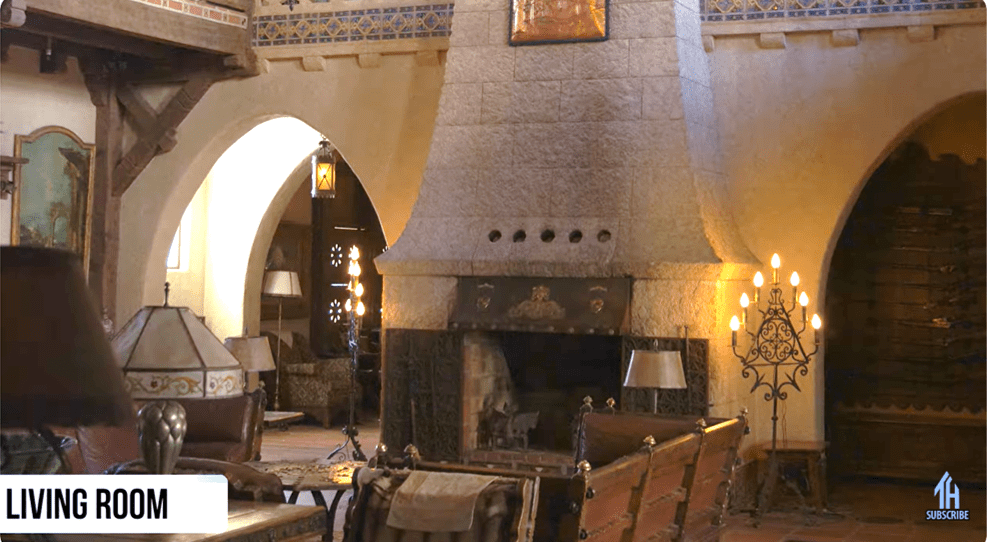
OK, not quite exactly the same. However, one must admit to some similarities. And Author Earl Derr Biggers definitely took inspiration from real-life people and places throughout his Chan novel.
Perhaps it wasn’t just serendipity that Charlie Chan Family Home Webmaster, Rush Glick, tells us Scotty’s Castle also served as inspiration for the Manderley Castle in the 1945 Chan film, Castle in The Desert, (scroll to bottom in the link to read his description.)
“Guessing is poor business that often leads to lengthy saunters down the positively wrong path.”
(Behind That Curtain, 1928, Chapter 15)


Very interesting. And the “castle” looks like I envisioned it from the novel. That is, the image in my mind was pretty similar to what I see in this photo.
LikeLiked by 1 person
Thanks Barbara. This book (for me) really had a unique plot twist. And I like how Tony, The Parrot, became a murder victim and made the title of the book. Not many birds get that opportunity :).
LikeLike
I’m happy to read how fired up your commitment to ‘all-things-Charlie-Chan’ truly is! But I sorely miss the postman who stole my heart with his voice. I reckon I’ll take whatever I can get and gladly read about his literary adventures understanding how he dearly loved this historic character.
LikeLiked by 1 person
Haha, you stole mine first, and taught me everything I know :)! Such wonderful days listening to you and Pierre at The Dragon Upstairs, or wherever you sang. You really packed em in…and still do!
LikeLike
I found this line very amusing; “…the old Spanish days in California before Iowa came.” Before Iowa came? 😀 Is this simply a reference to the western migration into California from exotic places like, Iowa? Or is there another meaning?
LikeLiked by 1 person
Well, I’ll admit you had me stumped on that (I had to ask the internet.) Apparently, prior to CA statehood in 1850, the architecture was Spanish Colonial (or Alta California style.) This was characterized by adobe bricks, thick stucco walls, red clay tile roofs, and courtyard layouts designed for, or by, missionaries. After Iowa achieved statehood (earlierin 1846) it apparently significantly influenced Western U.S. architecture, primarily through its role as a “Gateway to the West” in Council Bluffs and its pivotal development of the Prairie School style. Iowa acted as a laboratory for pioneering architects like Frank Lloyd Wright, whose Midwestern style later shaped suburban design across the West. So now we know! And we didn’t even have to ask Earl. Thanks for the comment, Fuzzyce.
LikeLike
thank you Lou for another fascinating trip down into the always entertaining Charlie Chan world
LikeLiked by 1 person
Great piece, Lou! Thank you! I think that you are possibly correct that the well-known Scotty’s Castle provided the inspiration for P.J. Madden’s desert estate in “The Chinese Parrot.” Also, I have always thought that the name “P.J. Madden” was based on that of J.P. Morgan, either J.P. Sr. or Jr. Interestingly, the latter was an alumnus of Earl Derr Biggers’ alma mater, Harvard.
-Rush Glick
LikeLiked by 1 person
Thanks Rush. As always your insight is most appreciated. I see what you mean about P. J. Madden and J. P. Morgan, then throw in the Harvard connection on top of that! If you take J.P. Morgan’s initials–J.P.M–and make a simple anagram–P.J.M–that gives us the fictitious P. J. Madden. Nice! T.Y.S.M.
LikeLike