
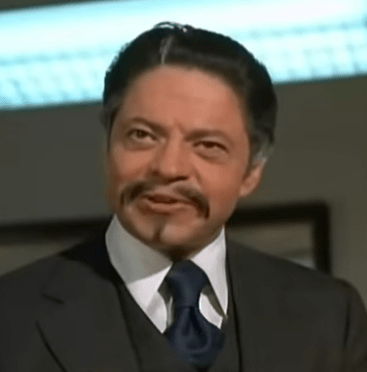
The last, and final attempt at a Charlie Chan series revival came in the 1970s. Filmed in 1971, but not released in the U.S. until 1979, The Return of Charlie Chan (or Happiness is a Warm Clue) was a huge success…disappointment. You probably guessed by now exactly who played Detective Chan, Actor Ross Martin.
In The Return of Charlie Chan, Detective Chan (Ross Martin) is coaxed out of retirement to solve the baffling case of an attempted murder of a Greek shipping tycoon (Leslie Nielsen) on the decks of his luxury yacht. There’s lots of tropes: shady characters, beautiful women, secret pacts, monied cruise members. And Charlie’s family life at home is well represented in this made for TV movie premier, which never got off the ground.
Martin is probably best remembered as one-half of the “cowboy-government agent” duo of James West (Robert Conrad) and Artemus Gordon (Ross Martin.), And in life he was quite a remarkable person. Born in Grodek, Poland (now part of Ukraine,) he came to the United States with his parents as an infant, September 18, 1920, and they settled in the Bronx. He spoke Polish, Yiddish, and Russian, before he ever learned English. Then later he learned French, Spanish, an Italian (don’t you hate people like that…um sorry.)
Anyway, He went on to earned a law degree from from National Univ. School of Law, which later became part of George Washington University. Despite the degree he chose radio, then television and theater as a career. He appeared in TV series, such as: One Step Beyond, Richard Diamond-PI, The Twilight Zone, Peter Gun, Hawaii Five-O, etc. Some old enough may remember him in the 1959-1960 TV series Mr. Lucky? A suspense-drama Martin starred in as Armando, assistant to Mr. Lucky in all 34 episodes. Mr. Lucky owned a large gambling ship and they sailed international waters letting folks gamble the nights away. And of course, from 1965-1969, he co-starred in 104 episodes of The Wild Wild West.
The IMDb website rated The Return of Charlie Chan at 5.6 out of 10 (by 198 viewers.) While Rotten Tomatoes website does not give it a rating, neither on their tomatometer nor the popcornmeter, stating “there are less than 50 ratings.” I will say though it wasn’t for the want of talented actors:
- Ross Martin: Experiment in Terror, 1962. The Great Race, 1965. And of course The Wild Wild West, 1965-69.
- Leslie Nielsen. Airplane, 1965. The Naked Gun films, 1988, 1991 & 1994. Dracula, Dead and Loving It, 1995. Wrongfully Accused, 1998.
- Richard Haydn. The Sound of Music, 1965. And Then There Were None, 1945. Ball of Fire, 1941.
- Louise Sorel. The Days of Our Lives (soap), 1992-2026. Airplane II: The Sequel, 1982. Santa Barbara (series), 1984-1991.
- Soon-Tek Oh. Mulan, 1998. Beverly Hills Ninja, 1997. Missing in Actin 2: The Beginning, 1985. The Final Count Down, 1980. The Man With The Golden Gun, 1974.
- Don Gordon. The Towering Inferno, 1974. Papillon, 1973. The Exorcist III, 1990. Bullitt, 1968.
- Peter Donat. The Game, 1997. The War of The Roses, 1989. The China Syndrome, 1979. The X-Files, 1995-2002. Flamingo Road (series), 1981-82.
- And many others: Earnest Harada, Adele Yokioska, Pearl Huang, Viginia Ann Lee.
So what happened? It wasn’t a bad mystery and some considered it a good attempt to revise the series. However, a couple of things were working against it:
First, a presidential commission to look into the causes of violence under President Lyndon B. Johnson. The Kerner Commission, 1967-68, was in response to over 150 riots in America 1965 – 1968, predominately between white police forces and the African-American communities they served. An ancillary finding of the study was that television was having a dramatic impact on society, desensitizing people to violence. Senator John Pastore of Rhode Island personally talked to Robert Conrad about The Wild, Wild West and told him that he believed it was harmful and should be canceled. Then in 1968, both Dr. Martin Luther King and Senator Robert F. Kennedy were assassinated. The Wild Wild West was cancelled in April 1969.
The second factor though is what really killed the series return: the publics’ growing sentiment against Hollywood’s practice of whitewashing in film; specifically Caucasian actors in “Yellow Face.” Here’s an excerpt from the site Grokipedia (which I’ve never set eyes on before today.):
“The decision not to develop The Return of Charlie Chan into a series, despite its completion as a TV movie that aired in 1979, signaled a pivotal moment in the decline of non-Asian actors embodying East Asian characters in mainstream American media. Advocacy from Asian American groups, amid the broader civil rights era, emphasized the perpetuation of stereotypes like pidgin English and exoticized wisdom. This outcome reflected growing empirical evidence from cultural studies of how such depictions reinforced marginalization, contributing to Hollywood’s tentative pivot toward authentic casting to mitigate backlash risks. (Footnote cited on Grokipedia: https://files.eric.ed.gov/fulltext/ED071442.pdf)
Although truly a master of disguise and mimicry on The Wild Wild West series, I don’t think Ross Martin made a convincing Charlie Chan; neither physically, nor in his manner of speech. Probably because growing up in the 50s & 60s watching those original films, I have those stereotypical sing-song voices, exaggerated features, and gesticulations, “Wait! Touch nothing” of the earlier actors Oland and Toler embedded in my mind (sorry Charlie.) It felt more a portrayal of say Hercule Poirot than it did Charlie Chan, for me.
The Chan novels by Author Earl Derr Biggers were set in the 1930s. Ironically the xenophobia and racism that eventually shelfed the detective, where actually one of the main underpinnings for the success of the novels and films: Charlie’s championing against them!
Should there ever be another attempt to bring Charlie Chan back in film, either on the Honolulu Police Force or out of retirement, it would probably be best as a period piece, 1930s-1950s. And unquestionably starring a highly recognized Asian actor. I’ve had my own ideas on that (here.)
Ross Martin, March 22, 1920 – July 3, 1981
“”May the four nails of his coffin be of purest gold”
(Keeper of The Keys, 1932, Chapter 18)
 The Postman on Holiday
Very informative. I always liked him in Wild, Wild, West. I’ll have to see if I can find this one!
LikeLiked by 1 person
Tony, yes. He certainly was a master of disguises on WWW (the show not the internet :). You can find it on Youtube these days. Thanks, Lou
LikeLike
Thank you, Lou, for an interesting look at the failed attempt to return Charlie Chan to the screen, albeit the small screen. Keye Luke, our Number One Son in the Charlie Chan film series, had no problem with an actor of European decent (Warner Oland) portraying the Chinese detective, as we see from interviews conducted later in that actor’s life, including one from 1985 for Canadian television, in which he stated, “Well, I call it artistry. I think that regardless of race, color, background, so on – if a man can create a character which you can believe, he is an artist and is entitled to the distinction of artistry, and I don’t think race has a thing to do about it. Furthermore, at that time there were no Orientals around that could have possibly played that part, for one thing. They might have some today, but I don’t know of any – that is, those that fit the Chan image – you know, that portly, genial sort of character.” Also, Keye Luke obviously had no issues with a Caucasian actor (David Carradine) starring in an Asian role in the “Kung Fu” TV series in the early ’70s, a series in which Mr. Luke was featured as Master Po.
In my opinion, Charlie Chan was but one of the victims of the iconoclastic mentality that took root in the late ’60s, a time in which nearly everything was turned upside down and inside out. We continue to be buffeted by the shock waves of that upheaval today within our culture as well as throughout western culture as a whole. I find it interesting that the clenched fists of those purportedly fighting for “the cause” have all too often squeezed the life from the cherished fruit of artistic expression, bringing us to a time in history when actors find themselves more and more limited in the roles they are allowed to play on stage or screen…while we might note an ironic exception in, say, the play “Hamilton”?
As it is the fashion of our era to judge, more often than not harshly, generations of the past, how might we ourselves be judged in turn by future generations?
LikeLiked by 1 person
Touché, Rush. I was thinking this one might get some interesting feedback. And of course, you make some very valid points. I’d planned to tweak it last night, with the below. However, the Sandman visited early and I did it early this morning. Thank you so much as always for your insight:
“So what happened? It wasn’t a bad mystery and some considered it a good attempt to revise the series. However, a couple of things were working against it:”
LikeLike
RETURN did too little to focus on the character in this criminal case.
A crime series set in the 1920s and 1930s would certainly be possible today. There are several successful examples, such as Murdoch Mysteries, which make extensive use of the technology of their time.
But also HBO’s Perry Mason, Babylon Berlin, Frankie Drake, and Miss Fisher’s Murder Mysteries.
A series of films, as was once the case with Columbo, would even be conceivable.
What made the novels successful still works today. Some topics need to be balanced sensitively today so as not to overwhelm the audience. The character’s problems can be seen around him, but they are not the main issue. Then it can work out.
LikeLiked by 2 people
Some insightful comments, Michael. I agree, they could have put more characterization to develop Charlie. Also, you make some good examples of how other period mysteries succeeded. TXS, Lou
LikeLiked by 1 person
I was unaware of Ross Martin’s (mis)adventure as the great detective. I like to collect information on Chan and his various incarnations and you, Lou, have done so much to keep us informed. Having read the novels, I enjoy playing with annotating them (ship and railroad schedules are a challenge). Thanks for your column.
Rich Cartwright
LikeLiked by 1 person
Rich, very nice that you’ve read the novels and “enjoy playing with annotating them.” That’s how all this started for me! I’ve so many sticky-notes and underlines in the books yet to visit/talk about. Interestingly, Biggers used many real-life people, places and things in the books. T.Y.S.M. Lou
LikeLiked by 1 person