
October is World Mental Health Awareness month; October 10th World Mental Health Day.
This month’s post originated from discussion with Charlie Chan Family Home member, Michael Votta Jr. (aka: “Mike in D.C.” to the Chan Family Home clan.) Professor Votta, currently serves as Interim Director of The School of Music and Director of Bands, University of Maryland.
You know Oscar Levant, right? Composer, concert pianist, conductor, author, radio game show panelist, television talk show host, comedian, and actor? You know, the guy recognized as chief interpreter of George Gershwin’s “Rhapsody in Blue?” The one who co-starred with Gene Kelly and Leslie Caron in An American in Paris? The guy at the piano with a cigarette always hanging off his lip? Yeah, him. Well, he actually wrote the operettic scores that Boris Karloff (as Gravelle) is heard singing in the film classic, Charlie Chan at The Opera (1936.)
Here’s a brief synopsis of what many consider to be the top film in the 40+ Chan catalog (You may skip this if you’ve already seen the film):
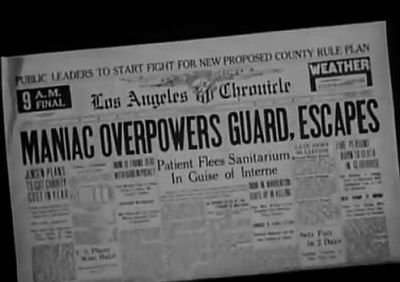
At Rockland State Sanitarium, Gravelle, (Karloff) an opera-singing amnesiac, regains some of his memory when he sees a newspaper article about prima donna Lilli Rochelle. He then overcomes a guard and escapes into the rainy night. In Los Angeles, Inspector Regan asks Charlie Chan, who has just completed the “Race Track” case to assist with this case. As they are in Regan’s office discussing the matter, Lilli Rochelle comes in, accompanied by her lover and fellow singer, Enrico Barelli, to report a threat that she will die that night. Though Charlie and his son are leaving that night on a boat for Honolulu, he accepts.
The Charlie Chan Family Home
When Boris Karloff (as Gravelle) sings we are hearing the musical score Oscar Levant wrote for the film, and Baritone Tudor Williams provides Boris Karloff’s operatic singing voice:
Songs: “March Funebre,” “Ah, Romantic Love Dream,” “King and Country Call,” “Carnival Marche,” and “Then Farewell” from the opera Carnival
The Charlie Chan Family Home
Music by Oscar Levant, Libretto (text) by William Kernell, Orchestrations by Charles Maxwell.
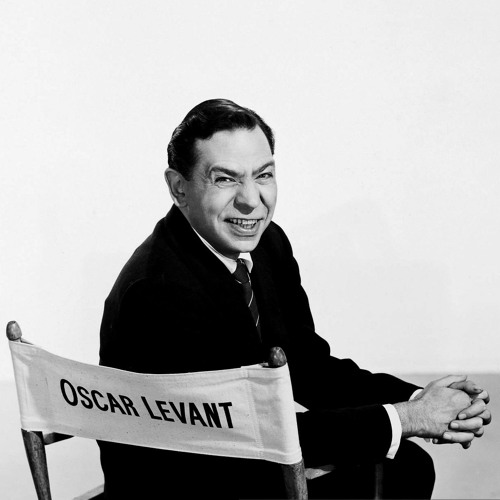
The irony of this outstanding composer and musician writing the music for this particular film is the mental illness aspect. The film’s character, Gravelle, played by Boris Karloff is thought to be mad and is institutionalized. In real life, in 2006 NPR memorialized Oscar Levant as “Hollywood’s first celebrity meltdown.” Levant considered himself a failure in life. He was an insecure, tortured soul who battled a 10-year addiction to painkillers and was shuttled in and out of mental institutions before his death in 1972. Rather kismet he of all people should score music for the one Chan film that leans heavily on the aspect of mental illness.
Check out this very brief PBS article and accompanying video: How the talented Oscar Levant broke taboos by talking about mental health (Dr. Howard Markel, Professor Univ. of Michigan.) It is a great summation of his struggles and courage to air them publicly at a time when this topic was generally taboo within Hollywood.
In April 2023, Sean Hayes (of Will & Grace) portrayed Oscar Levant in the Broadway Play “Good Night, Oscar,” which recreates Levant’s–temporary release from an institution–to guest on Jack Parr’s The Tonight Show in 1958. Here’s a rundown of the production on CBS Sunday Morning.
“There is no great genius without a touch of madness.”
– Aristotle, Tranquility of Mind, (A.D. 60)
“Very old Chinese wise man once say, “Madness twin brother of genius because each live in world created by own ego. One sometime mistaken for other.”
– Warner Oland, Charlie Chan at The Opera (1937)
“There is a thin line between genius and insanity. I have erased that line.”
– Oscar Levant, International Celebrity Register (1959)
 The Postman on Holiday